Most dispensary merch fails quietly. A customer takes the free sticker, peels the backing, and it never gets stuck to anything. The tote bag goes in a drawer. Six weeks later the budget line looks like a rounding error and nobody can say what it earned.
The merch that works does one specific thing: it survives long enough to be seen again. A grinder sits on a coffee table for years. A cheap lighter dies in a week. That difference, keep-time rather than cost, is the whole ranking logic below.
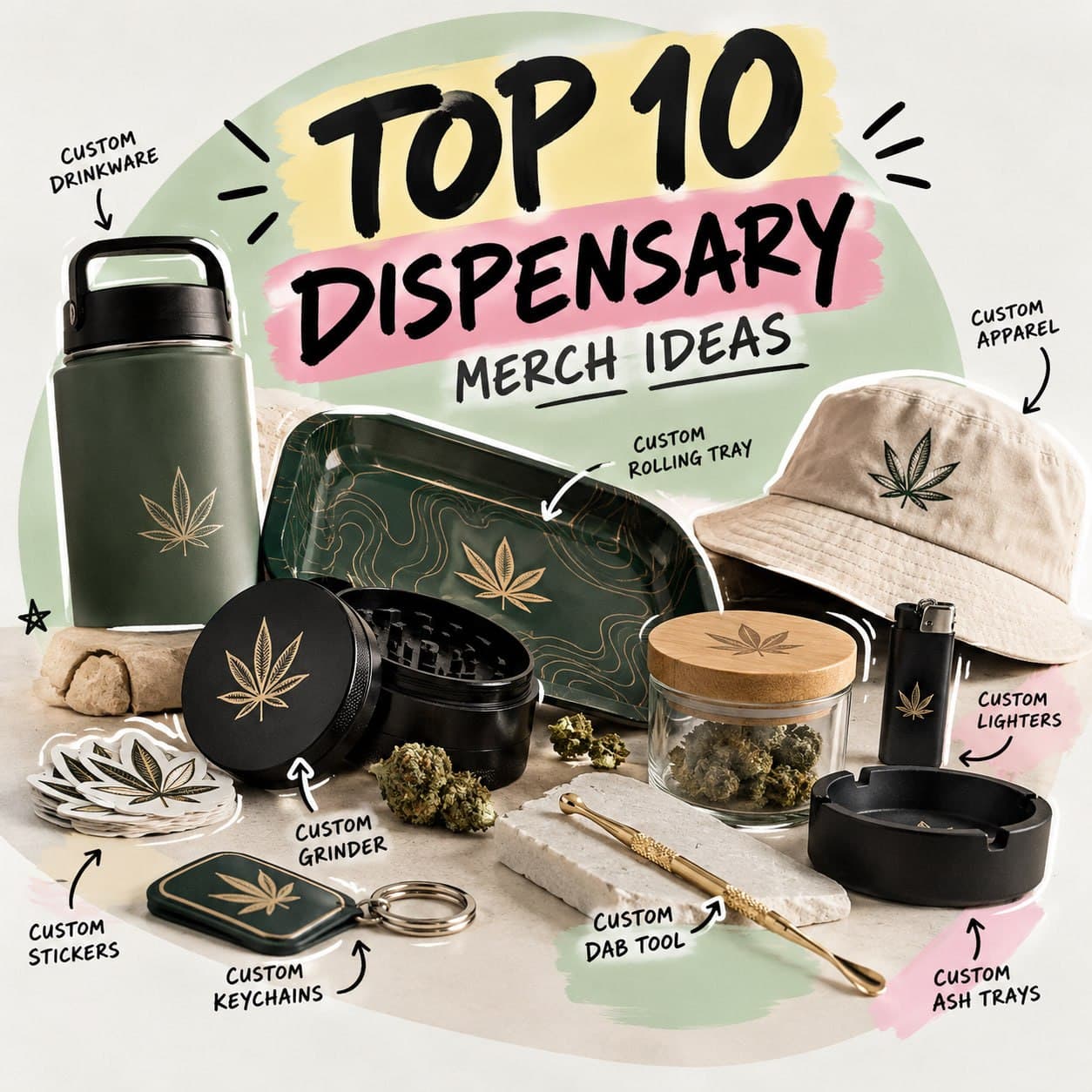
This list is ordered by what customers actually keep and reuse, not by price. Each idea says what it costs per unit at real quantities, and the last section covers the math of when merch pays for itself.
What the top 10 have in common
Every item below is scored on one thing: how long it stays in a customer's hands. A grinder that lives on a coffee table for two years keeps advertising for you; a lighter that dies in a week does not, however cheap it was to print.
Key Takeaways - Keep-time beats cost: a $5 grinder kept two years costs about 2 cents per brand view; a $0.60 lighter that dies in a week costs about 12. - Grinders, glass stash jars and rolling trays are the three longest-lived items; lighters and stickers are reach tools, not retention plays. - Merch tied to a spend threshold ("free grinder over $75") lifts basket size; merch handed to everyone reads as litter. - Most merch fails at ordering, not design: minimum-order policies kill the exact quantity a dispensary actually needs.
What customers actually keep is the thread through all ten.
1. Custom engraved grinders
Keep-time: years. Cost: from $4.99/unit at 1,000 (machined aluminium).
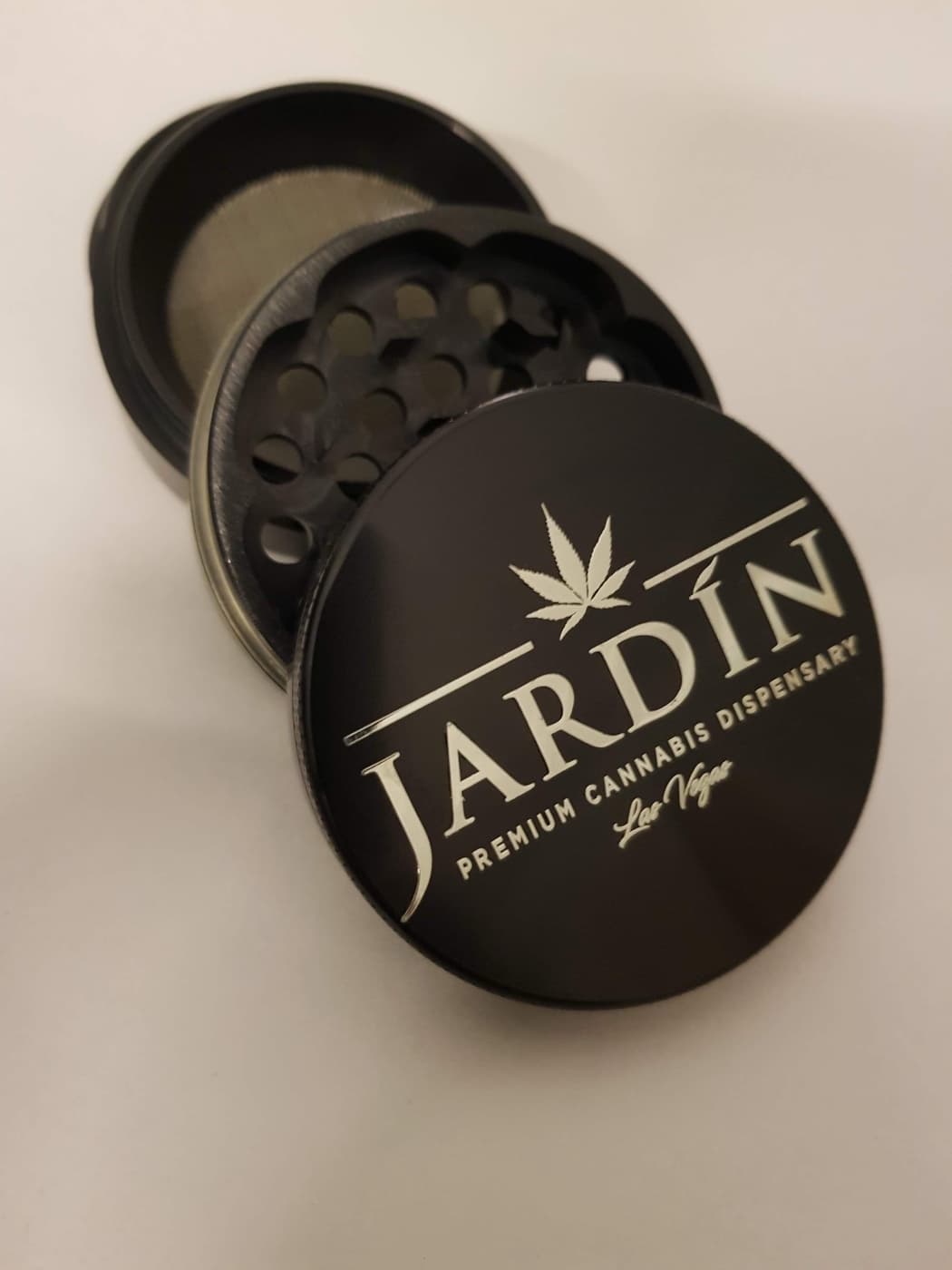
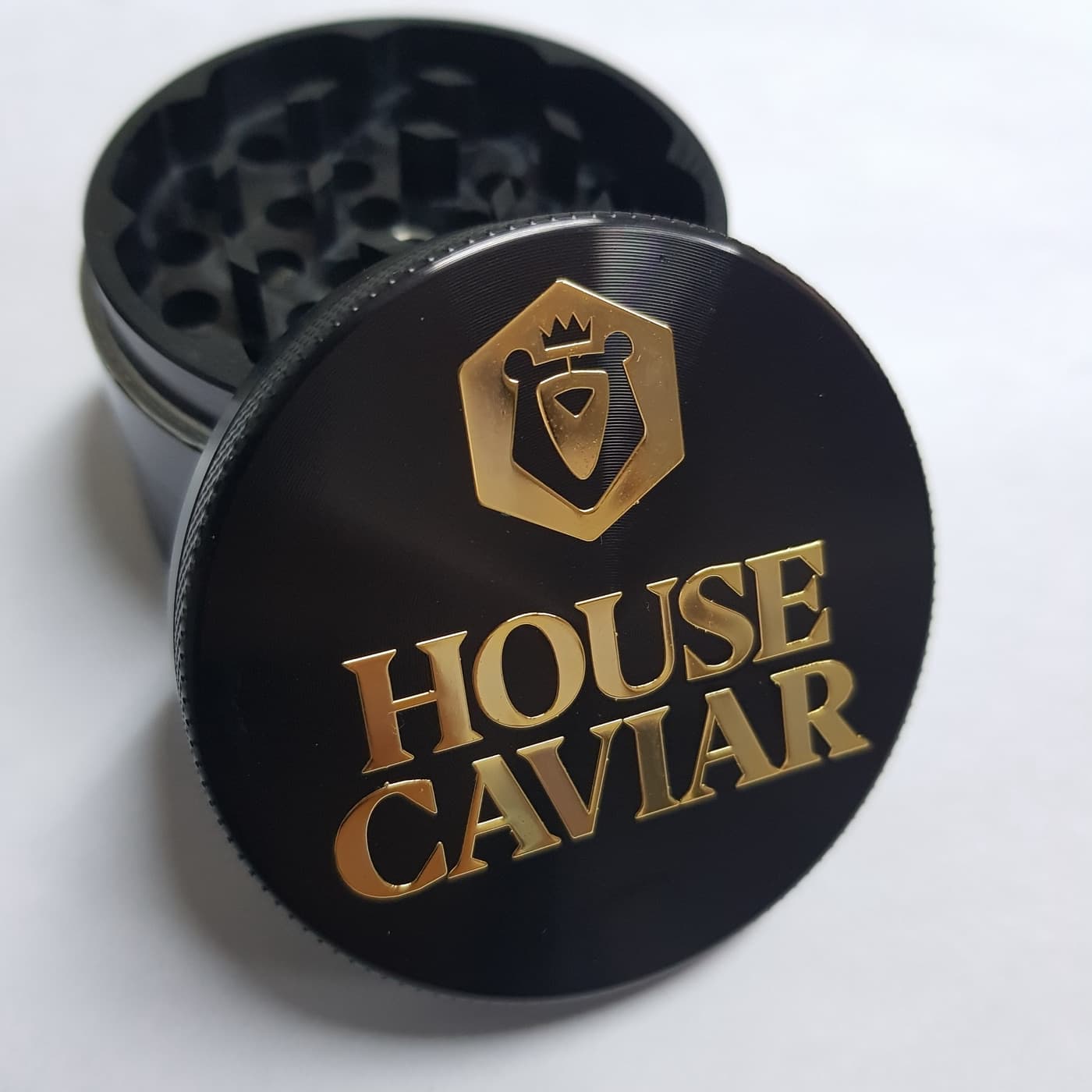
Nothing else on this list lives in customers' pockets or on their tables for years with a brand name machined into it. Engraving is permanent and cannot wear off like a print, and the weight of machined metal makes it feel like a gift rather than a giveaway.
This is the one item on the list we make, so take the bias into account. But it's also the item dispensaries reorder most with us: a dispensary that bought 250 two years ago reorders because customers kept asking where to get one. Our own order records show a 70/30 split, 70% of dispensary revenue from returning buyers, and that says the repeat behavior is on the product, not the pitch.
Best used as: loyalty-tier gift (free at a spend threshold), VIP event giveaway, or bound to a strain drop.
2. Branded glass stash jars
Keep-time: years. Cost: $3–8/unit at 500+.
A jar holds flower on a shelf, in full view, for as long as the customer smokes. Airtight glass preserves product better than the dispensary's own packaging, so the jar earns its place functionally, and the brand just lives on the lid.
The trap is weight: glass jars are heavy, and freight eats margins at scale. They work best as a local pickup incentive or in-store-only gift, not something mailed in an online order.
Best used as: in-store spend-threshold gift, flower-purchase bundle.
3. Custom rolling trays
Keep-time: 1–3 years. Cost: $2–5/unit at 500+.
A tray organizes the session, grinder, papers and lighter in one place, and metal trays with a raised edge outlive plastic ones by years. The printed surface is large, so the branding is legible across a room, not just in the hand.
Trays pair naturally with grinders as a set. A tray alone is nice; a tray plus an engraved grinder is a kit, and kits justify a higher spend threshold.
Best used as: bundled with grinders at a VIP tier, strain-launch merchandise.
4. Printed lighters
Keep-time: days to weeks. Cost: $0.50–1.50/unit at 1,000+.
Lowest cost per unit on the list, shortest life. A lighter gets borrowed, lost, or emptied in days, which makes it a volume play, not a retention play. At under a dollar each it's the only item here that can go into every single bag without a budget meeting.
The honest framing: lighters are a reach tool. They put the name in many hands briefly. They do not sit on a shelf advertising the brand for years. Use them for reach; use the items above for retention.
Best used as: with-purchase add-on for every transaction, event handout.
5. Branded apparel that people actually wear
Keep-time: 1–3 years, if the design is good. Cost: $8–20/unit.
Most dispensary t-shirts end up as sleepwear or paint clothes because they're designed like ads: logo big across the chest, nothing else. The ones that get worn in public look like streetwear with a small, well-placed mark.
The rule: design the shirt you would buy, put the brand where a fashion label would go, and print 50 instead of 500. A shirt worn to a concert outperforms a hundred shirts worn to bed.
Best used as: staff uniforms that double as product, limited drops for loyal customers.
6. Grinders and papers kits
Keep-time: years. Cost: $6–12/unit at 500+.
A small kit with a grinder, papers and a card solves the whole session in one object. Kits photograph well for social, give the dispensary a story ("our starter kit"), and raise the average gift value without a big per-unit jump over the grinder alone.
For newer smokers, the kit is genuinely useful in a way a single item isn't: everything needed, branded, in one box. That's the difference between merch and a product.
Best used as: first-purchase gift for new customers, tourist-market seller.
7. Weed grinders as event merchandise
Keep-time: years. Cost: from $4.99/unit.
Cannabis events, launch parties, 4/20 promotions: the merch that gets kept from events is the merch with a function. Attendees ditch flyers and stickers by the exit. A functional piece gets taken home.
Event orders are usually small (100–500 units) and needed fast, which is where minimum-order policies matter: a supplier with no minimum lets the dispensary order the real quantity instead of padding the order to hit a threshold.
Best used as: 4/20 giveaways, launch parties, expo booths.
8. Custom drinkware
Keep-time: 1–2 years. Cost: $4–12/unit.
Mugs and tumblers get daily use outside the cannabis context, which is exactly their strength and their compromise. The branding lives in a workplace or kitchen, reaching people during hours when a dispensary purchase is irrelevant but recall isn't.
Cannabis-branded drinkware works best with subtle marking for that reason: the customer will use a tasteful cup in public and hide a loud one.
Best used as: morning-purchase bundle (coffee-and-flower), staff gifts.
9. Silicone containers and dab tools
Keep-time: 6 months–2 years. Cost: $0.80–3/unit.
Non-stick silicone jars and dab tools serve a specific, daily-use niche. They're cheap enough to give broadly and sticky enough (in the keep-time sense) to outlast paper goods many times over.
Their ceiling is perceived value: a $1 silicone container rarely feels like a reward. They work as an add-on, not a hero gift.
Best used as: concentrate-purchase add-on, multi-buy bundle filler.
10. Stickers and papers
Keep-time: unpredictable. Cost: $0.05–0.30/unit.
Last on the list, though not because they're bad: they are the cheapest brand impressions money can buy. They are last because their keep-time is a coin flip. A great sticker gets stuck to a cooler and seen for years; most get peeled and discarded the same day.
Papers at least get consumed in use, so each pack guarantees a few brand-visible sessions. If stickers and papers are the whole merch budget, they're the whole problem. As a supplement to everything above, they're fine.
Best used as: always-in-the-bag filler, packaging seal.
What does dispensary merch actually cost?
The budget question isn't per-unit price, it's cost per retained impression. A $5 grinder seen three times a week for two years delivers roughly 300 brand views for $5. A $0.60 lighter seen a handful of times before it dies delivers maybe five. On that math the grinder costs 2 cents per impression and the lighter 12, six times more for the "cheap" option.
| Item | Cost/unit at volume | Typical keep-time | Cost per brand view (est.) |
|---|---|---|---|
| Engraved grinder | $4.99 at 1,000 | ~2 years | ~2¢ |
| Glass stash jar | $3–8 at 500 | ~2.5 years | ~1–3¢ |
| Rolling tray (metal) | $2–5 at 500 | ~2 years | ~1–2¢ |
| Grinder + papers kit | $6–12 at 500 | ~2 years | ~3–5¢ |
| Drinkware | $4–12 | ~1.5 years | ~4–8¢ |
| Silicone containers | $0.80–3 | ~1 year | ~5–10¢ |
| Apparel (worn) | $8–20 | ~2 years | ~5–12¢ |
| Printed lighter | $0.50–1.50 | ~1 week | ~12–25¢ |
| Stickers | $0.05–0.30 | coin flip | unmeasurable |
Note: our arithmetic, from the keep-time estimates in this list: assumes 3 uses a week for kept items and 5 total uses for lighters. Treat the order of magnitude, not the decimal.
Two rules hold across every item above:
Keep-time beats cost. The cheap item that dies is the expensive item per view.
Thresholds beat giveaways. Merch tied to a spend level ("free grinder over $75") reads as a reward and lifts basket size. Merch handed to everyone reads as litter. Our own order history is one long confirmation: dispensaries that tie merch to a threshold reorder; ones that blanket-giveaway mostly don't.
Frequently asked questions
What is the best merch for a dispensary?
Anything a customer keeps and uses. Custom engraved grinders top the list because they last years and carry a permanent 3D-engraved logo; glass stash jars and metal rolling trays follow. Printed lighters and stickers are reach tools, not retention items.
How much should a dispensary spend on merch?
Treat it as cost per retained impression, not cost per unit. A $5 grinder kept for two years works out near 2 cents per brand view, while a $0.60 lighter that dies in a week lands nearer 12 cents. Spending more on fewer, longer-lived items usually buys more visibility than spending less on disposable ones.
Do minimum order quantities apply to dispensary merch?
They often do, and they are where most merch plans die. A dispensary wanting 150 grinders for a loyalty tier can be blocked by a 500-unit minimum. Machined aluminium grinders are available from a single unit, so the order quantity can match the actual tier.
How do you make branded merch actually get used?
Tie it to a spend threshold rather than handing it to everyone. Merch that marks a tier ("free grinder over $75") reads as a reward and lifts basket size; the same item handed out indiscriminately reads as litter and gets treated that way.
How do you choose a merch supplier?
Most merch fails at the ordering stage, not the design stage. The usual failure is minimum order quantities: a dispensary wants 150 grinders for a loyalty tier, the supplier's minimum is 500, and the order dies in an email thread.
That's the gap we built for: machined aluminium grinders engraved with a real 3D logo, from a single unit, $4.99 each at a thousand. Free digital proof before anything is machined, worldwide shipping, no minimum at any quantity. If you want to see what your logo looks like engraved before committing a budget line, the quote takes a day: gmigrinders.com/wholesale-grinders.