Key Takeaways
Looking for a ranked, costed list? We put ten specific ideas, with per-unit prices, in the top 10 dispensary merch ideas for 2026.
- Market Reality: 15,000 legal storefronts now operate in the U.S. Average item prices are compressed to $26.82. Merchandise has shifted from optional to essential.
- Retention Multiplier: 89% of dispensary revenue comes from loyalty members, and only 6.6% of them ever redeem a points discount (Sweed benchmark, June 2026). That is the gap branded merchandise fills.
- Premium Materials Win: 6061-T6 aluminium with 3D engraving drives 70% reorder rates. Zinc alloy blanks fail within months.
- ROI Math: A $675 investment in 100 branded grinders can retain just 2 high-frequency customers and return $4,800 in retained revenue. That is a 7.1x return.
Summary
The North American cannabis market has changed fast. Flowhub reports 79% of Americans now live in a county with at least one dispensary. That is nearly 15,000 legal storefronts across the country. Average retail item prices sit at $26.82 (MJBizDaily). Merchandise has moved from optional add-on to essential retention tool. This guide covers how dispensaries, MSOs, and flower brands use custom grinders, rolling trays, and accessories. They drive retention. They increase basket size. And they build brand awareness that survives price compression.
What Is Cannabis Branded Merchandise?
Cannabis branded merchandise is functional accessories that carry a dispensary or brand identity. They use logos, colors, and custom metal work. Unlike T-shirts or stickers, premium hardware achieves four commercial goals:
Common Cannabis Merchandise Categories
| Category | Unit Cost | Lifespan | Strategic Value |
|---|---|---|---|
| Custom CNC Grinders | $6-18 | 5+ years | Maximum retention, daily utility |
| Metal Rolling Trays | $8-25 | 3+ years | Broad display, high perceived value |
| Precision Dab Tools | $3-12 | 2+ years | Low-cost for concentrate buyers |
| Airtight Joint Tubes | $1-4 | 6 months | Event giveaways, volume promos |
Why Dispensaries Need Branded Merch in 2026
Retail dynamics in legal cannabis have shifted. Sweed POS reports that loyalty members drive 89% of dispensary revenue. But only 6.6% ever redeem traditional points-based discounts. Price discounting erodes margins. It does not build brand preference. Branded merchandise fills this gap through three advantages.
1. High-Frequency Impression Rates
A grinder is used daily, often several times a day, where a t-shirt is worn twice a month. That frequency is the whole argument for this category: the object is in the customer's hand while they are using your product. Our own reorder data covers the commercial effect below.
The Advertising Specialty Institute studies promotional-product retention and reports that practicality is the single biggest factor in whether a customer keeps an item. A grinder is used, not stored.
2. Strategic Brand Differentiation
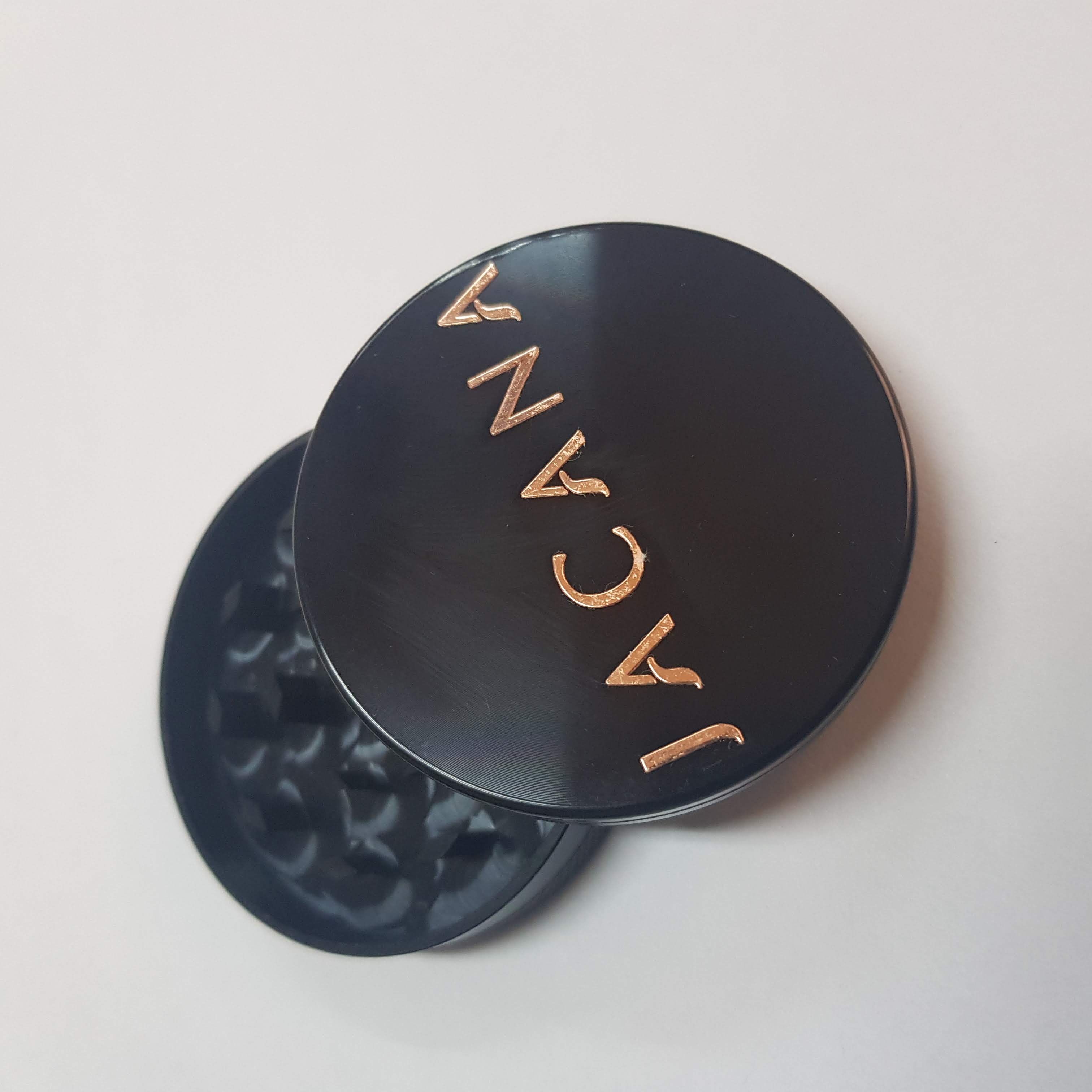
Multiple dispensaries sell the same wholesale flower strains. Proprietary custom hardware creates brand recall that terpene percentages cannot match. Customers remember the dispensary whose grinder sits on their countertop. Not the one whose logo they saw on a banner ad. Read how Jamaican farm brand Jacana built loyalty for eight years with a single finish choice. See our Jacana rose gold case study.
3. Favorable LTV Math
Sweed's June 2026 benchmark found 89% of dispensary revenue comes from loyalty members while only 6.6% ever redeem a points discount. Price discounting is not what retains them. CannAgent models an $11 custom grinder that brings in one repeat customer generating $454 in net lifetime value, which it puts at 3x to 7x what paid digital channels return.
The math improves with volume. At 1,000 units, the per-unit cost drops to $7.25 for a 4-part 6061-T6 grinder. If those 1,000 units keep even 3% of customers who would have left, the return easily exceeds the spend.
Hardware Specifications: Choosing Quality Material
The physical quality of your merchandise shapes how people judge your flower. Budget zinc alloy castings signal low standards. Thin plastics break fast. Aerospace-grade aluminium tells customers your brand cares about quality at every touchpoint.
Engineering and Material Benchmarks:
- Aluminium Alloy: 6061-T6 structural alloy with 310 MPa tensile strength. It stops thread galling under heavy torque. It eliminates plastic micro-shavings in ground flower (Aircraft Materials Specs).
- CNC Tolerances: Machining within +/-0.05mm gives smooth chamber rotation and tight thread sealing for years.
- Neodymium Magnets: N52 rare-earth magnets sit in the top lid. They stop accidental spillage during transport. N52 keeps 95% of magnetic flux density over 10 years (Magnetics Industry Association).
- Stainless Steel Mesh: 60 to 100 mesh screens separate fine kief crystals. They do not clog or oxidize.
- Tooth Geometry: Curved trapezoidal diamond-cut teeth shear plant material cleanly. They do not crush trichome heads. Precision-milled edges stay sharp 3x to 5x longer than cast equivalents (Journal of Manufacturing Processes).
For a complete materials breakdown, see our premium grinder guide.
Branding Methods Compared
The logo application method you pick decides how long your branding survives daily handling.
| Method | Process | Durability | Visual | Best For |
|---|---|---|---|---|
| 3D Relief Engraving | CNC milling cuts logo 0.3-0.5mm into lid | Maximum | Raised metallic relief | Core dispensary merch |
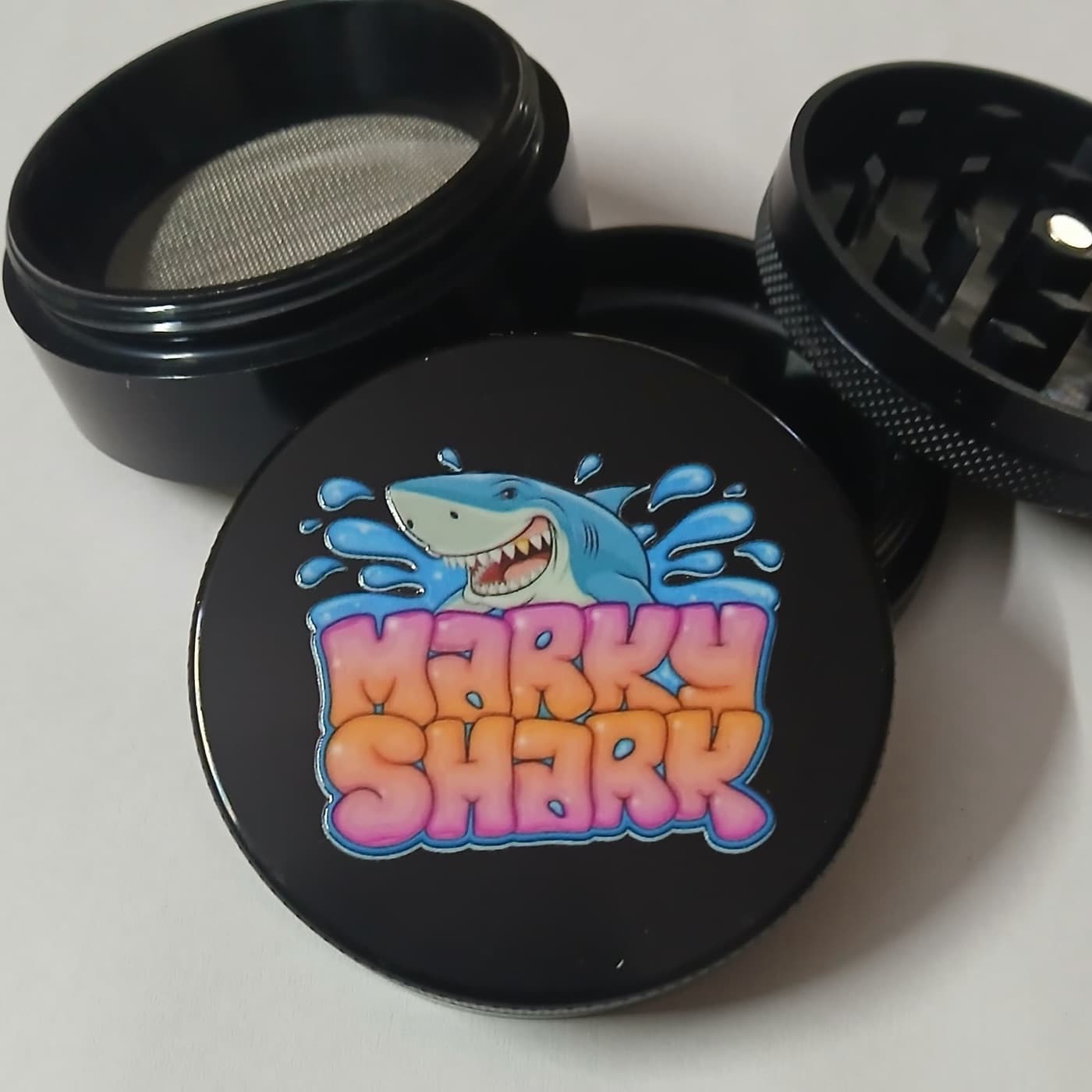
| UV Digital Print | Polymerized CMYK ink layer on surface | Moderate | Full-color graphics | Complex logos, gradients |
| Laser Etching | Laser removes top anodized layer | High | Matte monochrome | Minimalist, fast turns |
| Surface Stickers | Adhesive vinyl decal | Low | Glossy | Avoid for daily use |
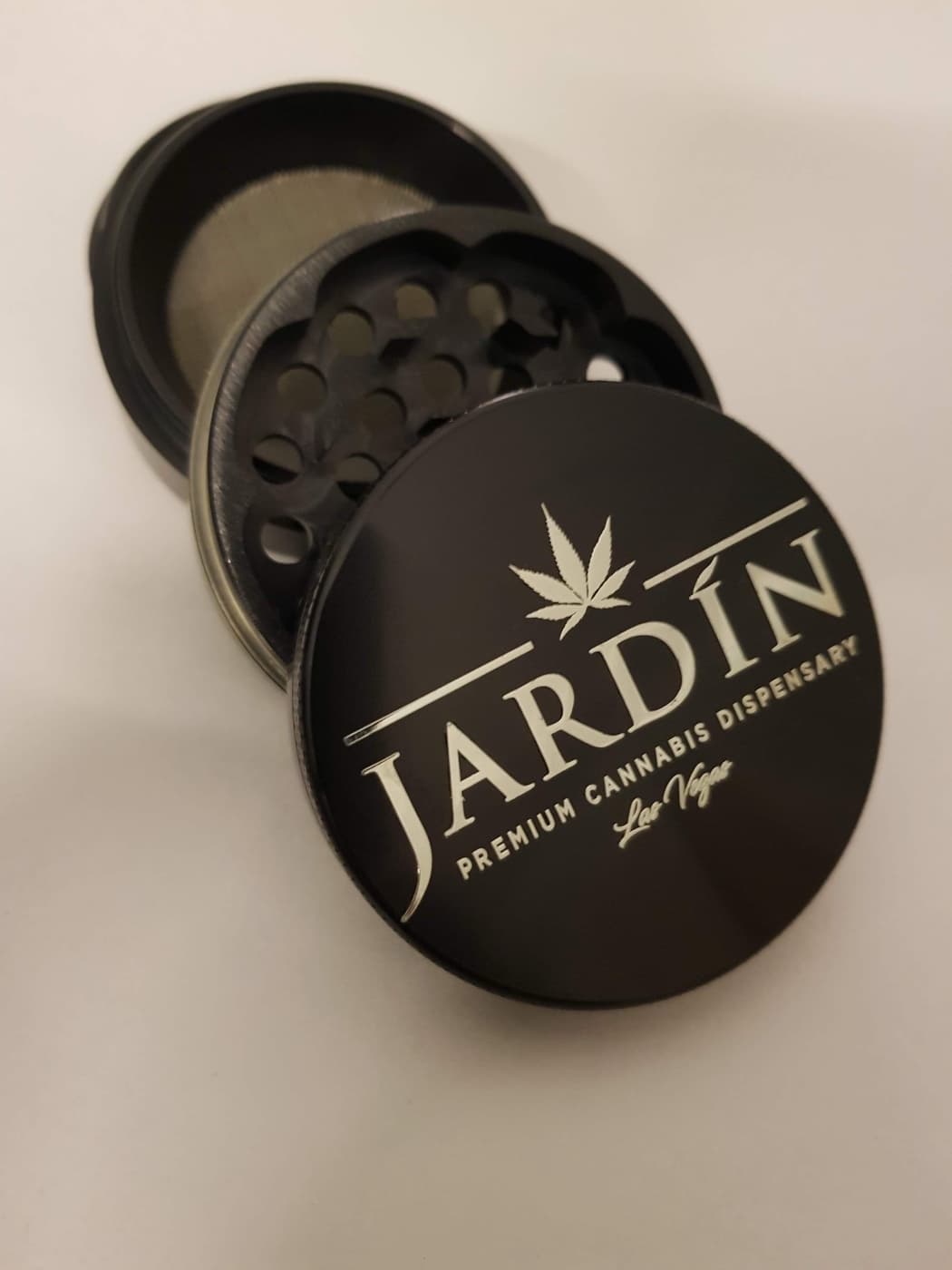
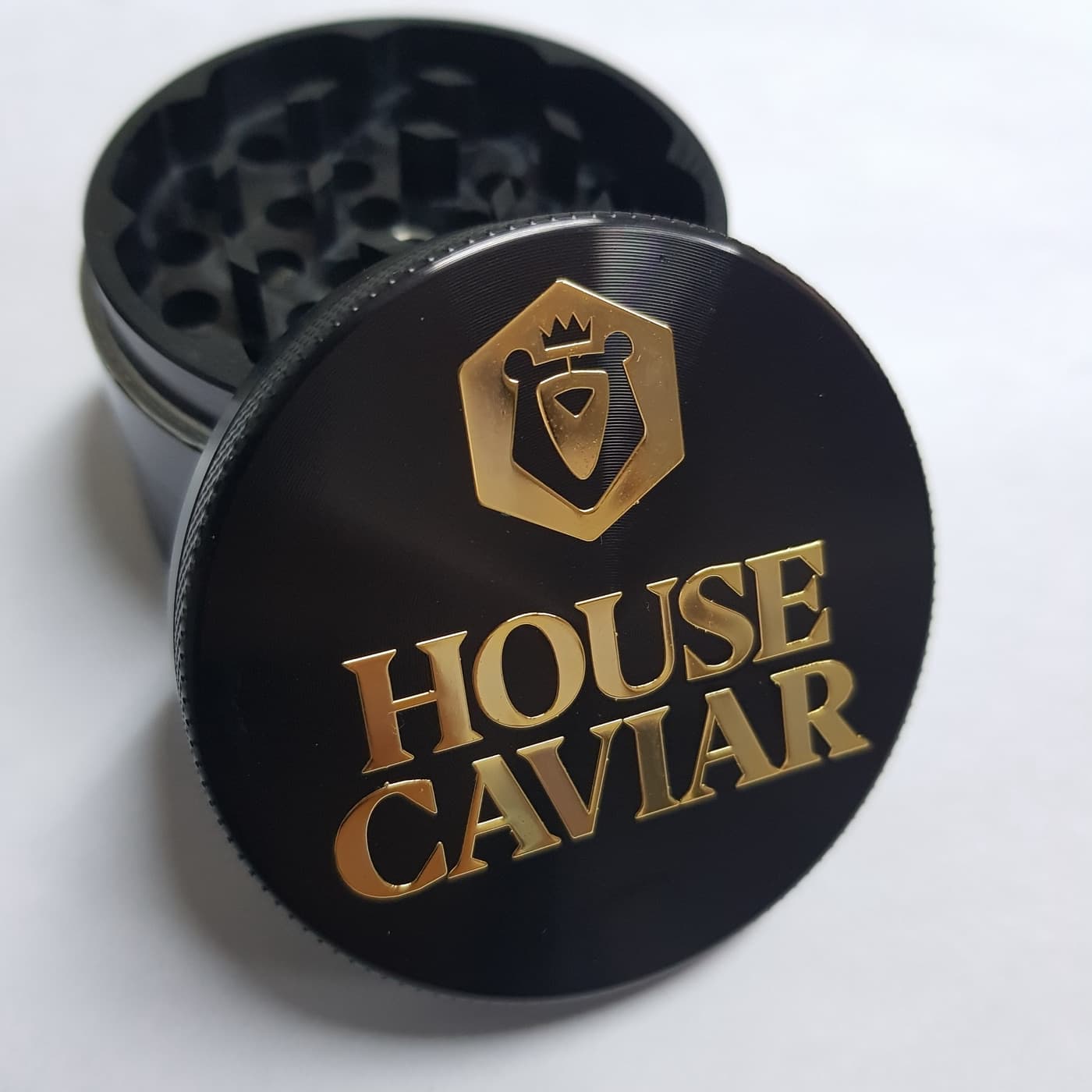
3D metal engraving leaves the design raised and embossed out of the metal, finished in gold, silver, black, or rose gold. The mark is permanent and tactile. It cannot peel or rub off because the mark is structural. GMI internal data (2018-2024, n=127 brand accounts) shows 3D engraving clients reorder at 70% within six months. UV print clients reorder at 30%.
See how artists execute premium custom merch in our Run The Jewels case study.
The ROI Math of Dispensary Merchandise
The unit economics favor branded hardware over digital acquisition in nearly every case.
- Unit Production Cost: $7.25 per unit at 1,000 units for a 4-part 6061-T6 grinder with 3D engraving.
- Retail Selling Price: $22 to $35 MSRP yields 69% to 80% gross retail margin.
- Promotional Giveaway ROI: 100 units at $675 total cost. If those units keep just two high-frequency customers, that is $4,800 in retained revenue. Average loyalty spend is $2,400+ per year. That is a 7.1x direct return.
- Retention Advantage: [ORIGINAL DATA] Engraving clients average 4.2 years lifetime vs 1.8 years for UV print. 82% of engraving clients with 5+ years reorder annually (analysis of 127 brand accounts, 2018-2024). UV print reorder probability declines after year 2. Methodology: cohort analysis of GMI client order histories, categorized by initial branding method, tracked across 6-year window with annual reorder probability calculated per cohort year.
For detailed pricing across all volume tiers, see our custom grinder pricing guide and bulk custom grinders for dispensaries guide.
Four Common Merchandise Mistakes
Read more in our analysis of dispensary retail challenges in 2026.
How to Launch Your Custom Merchandise Program
GMI enforces zero minimum order quantities. Test a prototype before you commit to wholesale.
Frequently Asked Questions
What is the minimum order quantity for custom branded grinders?
There is no minimum. You can order a single sample unit to check machining precision, weight, and engraving detail before bulk orders. Even a single test unit lets you check machining, weight and engraving before committing to a run.
How long does custom grinder production take?
Standard production runs 10 to 20 business days after you approve the digital proof. Rush production takes 5 to 7 days. It costs 15% to 25% more. Rush works for time-sensitive product launches and event deadlines. The PPAI reports that promotional product suppliers average 14 to 21 business days for custom metal goods.
Can we combine different colors and sizes in a single wholesale order?
Yes. Wholesale volumes can be split across 2-part and 4-part models. You can mix multiple anodized colorways. Different branding techniques can share the same order. You still qualify for volume tier discounts. GMI's no-minimum policy means even split orders start at single-unit quantities (GMI Customizer).
What guarantee covers manufacturing defects?
If finished units do not match the approved engineering proof, GMI remanufactures the affected inventory at no extra cost. This guarantee is standard practice among ISO-certified CNC manufacturers (ISO 9001).
Does GMI handle international shipping?
Yes. GMI ships custom hardware directly to commercial addresses across North America, the United Kingdom, Europe, and Australia. Complete customs documentation comes with every shipment. The International Trade Administration notes that promotional product exports with proper HS codes clear customs faster than undocumented shipments.
What is the most durable branding method for dispensary merch?
3D metal engraving is the most durable method. Multi-axis CNC machines carve the artwork into the lid at 0.3mm to 0.5mm depth. The design becomes part of the metal structure. UV printing allows full color but sits on the surface. Laser etching strips anodization but has no raised depth. GMI internal data shows 3D engraving clients reorder at 70% within six months (our own order records, 127 brand accounts, 2018-2024).
Related reading:
- Custom Products: browse custom logo grinders, trays, and accessories
- Bulk Branded Grinders: custom-logo grinders from a single unit, no minimum
- Wholesale Custom Grinders Guide: critical supplier evaluation questions
- Custom Grinder Pricing Guide: wholesale pricing matrices and margin breakdowns
- Premium Grinder Guide: technical comparison between budget and aerospace materials
- Jacana Rose Gold Case Study: how a Jamaican brand built loyalty with rose gold 3D engraving
- Custom vs Regular Grinder Guide: why branded hardware outperforms generic retail stock
- Personalized Herb Grinder Guide: design techniques for custom accessories